
Blue Ridge Community College Receives Clean Audit
Today, the North Carolina Office of State Auditor released its report on the finances of Blue Ridge Community College and found no material error for the year.
In the report, State Auditor Dave Boliek said, “Serving Henderson and Transylvania counties, Blue Ridge Community College offers more than 200 degrees, diplomas, and certificates. Given the College reports $42.1 million in revenues and $41.8 million in expenses, it is important that proper financial control is maintained in the community college’s daily operations… Our audit of Blue Ridge Community College’s financial records shows no material errors for the year ended June 30, 2025. I’d like to thank Blue Ridge Community College and their staff for their assistance and cooperation as our team conducted this audit.”
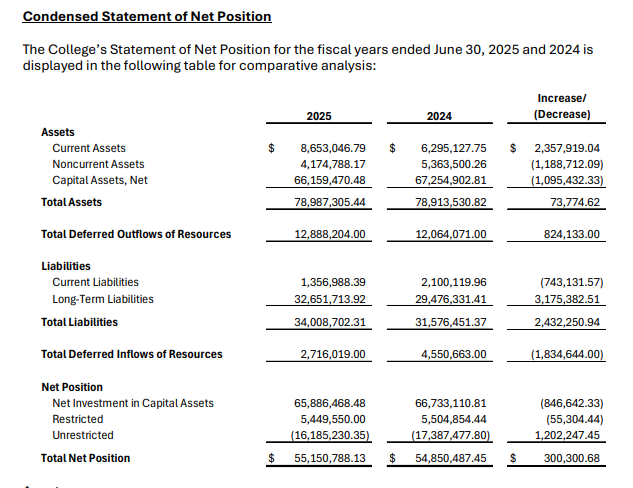
Highlights from the report:
“The State of North Carolina provides the majority of the College’s funding through its formula budget based on full-time equivalent (FTE) enrollment. Because enrollment is the primary driver of state appropriations, fluctuations in student numbers significantly impact financial planning.”
“County aid remains strong, with ongoing support from both the Henderson County and Transylvania County Boards of Commissioners. This local funding is essential to maintaining and enhancing campus facilities. Notably, the College is working with Henderson County to plan for the construction of a new facilities building. The level of county support continues to play a vital role in advancing the College’s mission and ensuring safe, modern, and effective learning environments.”
“Through careful fiscal stewardship, the College has maintained a strong financial position. Sound financial practices ensure the College remains within budget while still investing in students and community priorities. If necessary, adjustments to staffing or operations will be made to preserve financial stability.”
“The College remains well-positioned to advance its mission through strategic enrollment initiatives, strong county partnerships, external funding opportunities, and disciplined fiscal management. Together, these efforts support both the College’s long-term sustainability and its ability to serve the region’s educational and workforce needs.”
