
Dogwood Trust and Independent Monitors Host Educational Community Meetings
This week, Dogwood Health Trust and Affiliated Monitors facilitated two community meetings, one in Brevard and the other in Asheville. The meetings reviewed the findings of the Independent Monitor 2024 report, provided information on the compliance process, and facilitated smaller meetings with the monitors and other community stakeholders including HCA, North Carolina Department of Human Services, and the North Carolina Department of Justice.
The meeting started with Dogwood Health Trust explaining their role. The organization provides grants to support healthcare and prosperity across Western North Carolina and overseeing the compliance with the 2019 Asset Purchase Agreement, through hiring an Independent Monitor. Since 2024, Affiliated Monitors has been hired as the Independent Monitor and the team lead for that group explained the 2024 report.
In the 2019 Asset Purchase Agreement, HCA made 15 commitments. The team leader confirmed that HCA had completed the capital improvement projects and most of the other commitments were fully underway. And that most of the commitments in progress are in progress because they are commitments that are executed over ten years. Gerald Coyne, who is the co-team leader for the affiliated monitors team, led the presentation.
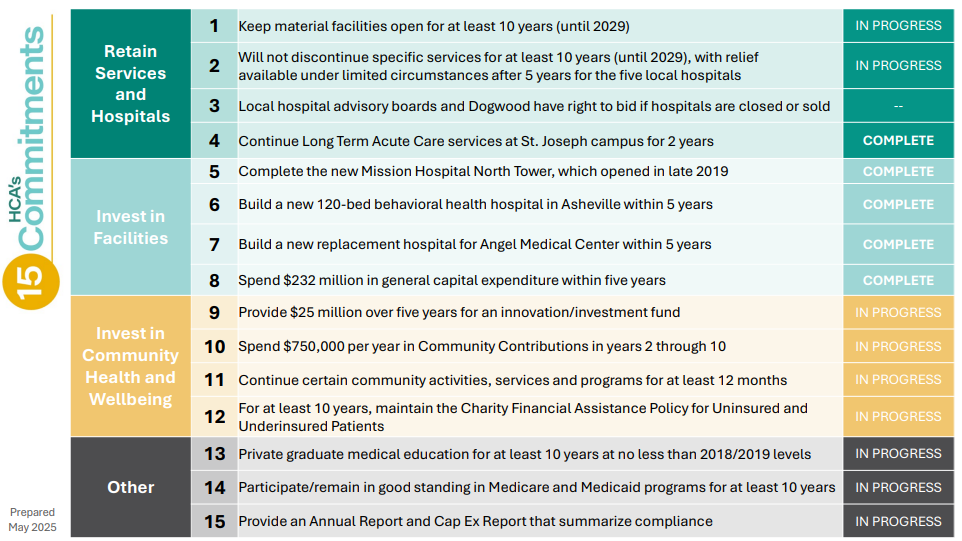
The Independent Monitor did highlight the three “potential noncompliance” issues mentioned in their 2024 report: concerns about continuing services, participation and good standing with Medicare and Medicaid services, and charity care. The team leader noted that the issue of continuing care is vague and unclear, which is why the Attorney General filed litigation on behalf of Dogwood to get clarity. He noted that HCA pushed back against the suit and that the suit is likely headed toward trial because there are several facts in dispute.
On the issue of participating in Medicare and Medicaid, the Independent Monitor noted that HCA has always receive funds from the program and “good standing” is rather unclear. But the Independent Monitor indicated that because of the immediate jeopardy warnings may mean that they find that HCA is not in “good standing.”
On the final issue of “potential non-compliance” is charity care. Coyne noted that this area was significantly altered because North Carolina changed the state law after the agreement. He then went on to say that they will be closely reviewing documentation to ensure that charity care has not dropped off, but overall, the situation has changed because of the new legal landscape.
After the Independent Monitor report, a representative from the North Carolina Department of Health and Human Services gave a presentation on how the state agency works with the Center for Medicare and Medicaid services to regulate hospitals. He explained that the state largely acts as the agents of the federal government, often fielding the front-line complaints and reporting them back. He then explained that usually regulators issue a formal warning and then review a plan of corrective action to bring the hospital back into compliance. In some cases, hospitals receive fines, specialized trainings, and as a last resort are dropped from the program. The department then said that transparency into these investigations can be challenging because of patient privacy concerns and lack of authorization from federal officials.
The meetings concluded with an opportunity for attendees to have smaller, more private, meetings with stakeholders including HCA, North Carolina Department of Justice and Department of Health and Human Services, and the Independent Monitors directly. The Independent Monitors also encourage attendees to reach out to set up small groups or individual meetings to help them better understand what is happening.
Tim’s Take: There is a disconnect between the tone of the Independent Monitor and the activist hysteria on this issue. Throughout his presentation, the lead monitor nuanced his concerns and pointed out that there was room for interpretation in how to implement the asset purchase agreement. But the activists and their partners in the media continue to paint the situation as a doomsday scenario. The real risk is that people will not access the healthcare they need, because of unfound rumors circulated by activists, instead of following sound, professional opinion.
