
Guest Post: A WNC voting fight gets state unanimous approval
Editor’s Note: This article first appeared in Cops and Congress, a Rutherford-based Substack written by Annie Dance.
The real issue isn’t politics; it’s whether people support journalism or ignore it to support a narrative, and whether local board members can make their own call.
The North Carolina State Board of Elections finally settled the immediate dispute today over early voting in Jackson County, in western North Carolina, for the general election.
But too much of the discussion has focused on turning this into a story about Republicans versus Democrats. That’s partly true, but there’s important context that’s missing in the public reporting and analysis.
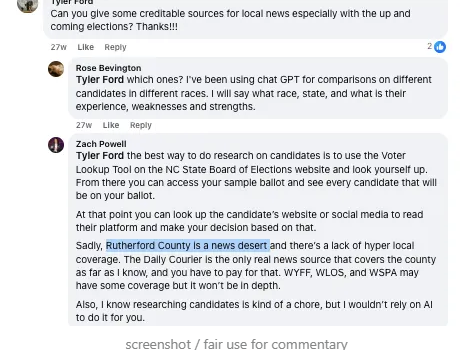
Earlier this year, a Democrat operative at Western Carolina University with Rutherford County ties attempted to spin his narrative into something apparently about my journalism.
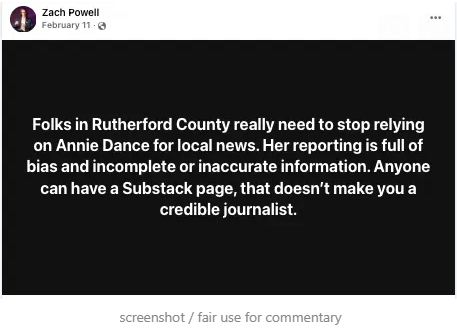
This story isn’t about me or a college polling location; it’s about state law. He and others sued the state board of elections, and the case was dismissed, according to federal court records. One thing I agree with is that Rutherford County has historically been a news desert. To be clear, I’ve been a journalist for over 20 years.
Fast forward to now.
Dallas Woodhouse, the former elections liaison at the NC Auditor’s Office, shouldn’t be made the villain simply because he was involved in conversations with local elections officials. The same goes for Jackson County Board of Elections members who were trying to sort through competing locations with legitimate logistical concerns.
The actual issue is whether the Jackson County board was allowed to deliberate, debate, and vote without alleged influence over their votes.
That’s a question worth asking without assuming the answer.
The State Board ultimately approved the majority plan featuring Western Carolina University’s Health and Human Services building and added the Cullowhee Recreation Center. The result gives Jackson County voters five early voting sites for the November general election.
That’s a practical outcome.
The controversy began after Jackson County reduced its early voting locations from five to four for the March primary. The Cullowhee Recreation Center had been used for early voting for about 18 years. Western Carolina University’s University Center had served as an early voting location since 2016.
For November, the county considered the HHS building and the Recreation Center.
There were legitimate arguments on both sides.
Supporters of the HHS building said it was well known in the community and had previously been used to administer more than 10,000 COVID-19 vaccinations.
The Recreation Center’s supporters pointed to parking, accessibility, familiarity and space for campaign activity.
Those aren’t partisan arguments. They’re election-administration arguments.
The State Board heard those concerns Thursday before reaching its decision. What made the Jackson County dispute unusual was the allegation of political pressure.
Republican board member Jay Pavey said he had been warned that he could be removed from the county elections board if he did not vote a particular way.
Pavey later described the issue to the State Board this way:
“Today you think we’re probably here to decide whether or not we’re going to select the health and human sciences building or the recreation center for the voting site,” he said. “But the reality is what we’re here for today is to decide whether or not you’re going to align yourself with the bipartisan majority vote or a vote that was cast due to being pressured.”
That’s a serious allegation. It deserves scrutiny. But scrutiny isn’t the same thing as a conviction. There is a difference between political officials communicating their preferences, election officials discussing those preferences, and someone actually coercing a board member.
That distinction matters.
Woodhouse, who worked with county elections boards through the state auditor’s office, has been portrayed by some critics as the central figure in the dispute. But communications and political disagreement, by themselves, don’t establish that Woodhouse illegally or improperly controlled the Jackson County board. The same standard should apply to the board members.
Bill Thompson’s opposition to the HHS site does not automatically mean he was acting improperly. He raised concerns about accessibility, parking and voter familiarity. Pavey’s support for the HHS building does not automatically make him more independent. Both are entitled to their positions unless evidence demonstrates otherwise. That’s how accountability works. It requires evidence. It requires documentation. And it requires the willingness to follow the facts even when they don’t fit the preferred political narrative.
There was also a broader question about the role of political parties. Francis DeLuca, chairman of the Republican-controlled State Board of Elections, acknowledged that political parties pressure local elections board members. “The parties on both sides put pressure on local members to do what they want. Both Republicans and Democrats,” DeLuca said. That statement shouldn’t be used as an excuse. It should be a reminder that political pressure is nothing new in American politics. The important question is whether that pressure crossed the line into improper interference with an official government decision.
If it did, the public should see the evidence. (Cherry-picking public records to support a narrative isn’t new.) If it didn’t, people shouldn’t manufacture a scandal simply because Republicans disagreed with one another.Thursday’s vote provides a sensible resolution to the immediate dispute. The HHS building stays in the plan. The Cullowhee Recreation Center is added. Jackson County gets five early voting sites. Voters get more access.
Now the political theater should give way to facts. If someone threatened a board member with removal, show the evidence. If someone improperly directed a board member’s vote, establish who did it and under what authority. If neither happened, say that plainly.
Conservatives should demand that standard.
Don’t defend government officials because they are Republicans. Don’t condemn them because they are Republicans. And don’t turn a complicated local election decision into another partisan food fight. The job is much simpler: Follow the evidence. Hold the right people accountable. Leave the rest alone. At the time of this publication, I’m still watching the now 11-hour-long State Board of Elections meeting.
