
Guest Article: G20 security echoes Asheville’s extraordinary wartime diplomatic history
Editor’s Note: This article first appeared in Cops and Congress, a Rutherford County-based Substack written by Annie Dance.
The international officials arriving at Asheville’s Grove Park Inn this week are here voluntarily, carrying briefing books instead of being escorted behind guarded gates.
But the setting has a remarkable memory.
As the 2026 G20 Finance Ministerial brings finance ministers, central bank governors and other senior officials to Asheville, local police are working with federal, state and regional partners on a security operation around the same resort where the U.S. government confined hundreds of foreign diplomats during World War II.
The circumstances are vastly different.
The security challenge is not.
The G20 is a federal diplomatic event taking place inside a North Carolina city. That means federal officials must protect foreign dignitaries and the integrity of the meetings while Asheville police remain responsible for the safety of everyone outside the summit’s security perimeter.
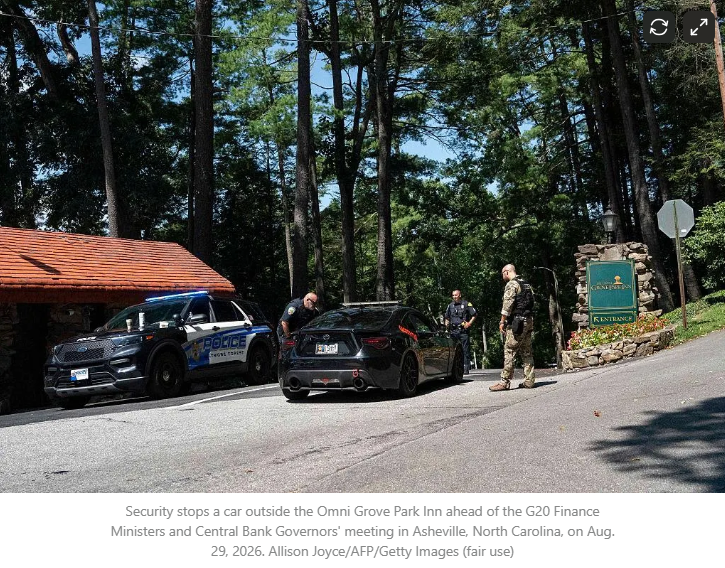
It is a partnership between Washington and local law enforcement that most residents may notice only through checkpoints, additional officers and restricted access near the Omni Grove Park Inn.
Behind those visible measures is a much larger effort to coordinate security, transportation, emergency response and access to the meeting site.
And the choice of Asheville carries an unusual historical resonance.
A federal security mission in the middle of Asheville
The Asheville Police Department has described its role as supporting federal partners while working alongside local law enforcement and emergency-management agencies.
“APD’s role in relation to the G20 Finance Track meeting is working alongside several local law enforcement and emergency management agencies to support our Federal partners and ensure the safety and security of the summit,” Asheville police spokesman Rick Rice said.
The G20 is not simply another large event for Asheville police to staff.
The United States is hosting representatives of foreign governments, and the federal government has the primary responsibility for protecting those officials.
But federal security does not happen in a vacuum.
The summit is surrounded by Asheville streets, neighborhoods, businesses, residents, and visitors. Local police continue to answer calls, investigate crimes, manage traffic, and handle emergencies while simultaneously supporting the federal operation.
The result is a layered security structure.
Federal partners provide the national and diplomatic security mission. Local and regional agencies provide community knowledge, local emergency response, and manpower. State agencies can provide additional resources when needed.
For Asheville, the objective is to secure the summit without turning the surrounding city into a security lockdown.
That is why checkpoints and controlled access around the Grove Park Inn are more significant than they might initially appear.
Police have said there are no planned permanent public road closures associated with the summit. Instead, security is concentrated around the meeting site, allowing authorities to control who enters the secured area while keeping public roads open.
It is a relatively low-profile approach to a high-profile security assignment.
The unseen work behind the checkpoints
A checkpoint is the part of a security operation the public can see.
The planning behind it is considerably more complicated.
Authorities have to determine who is authorized to enter the property, how visiting delegations will move through Asheville, where emergency vehicles can travel, how police resources will be deployed and how the operation will continue without compromising ordinary public safety.
The federal government also arranged transportation and security-related services for the G20 meetings, including law-enforcement coordination.
That matters because an international summit creates a security footprint extending beyond the building where the meetings take place.
Officials are moving between hotels, transportation points and meeting locations.
Vehicles carrying diplomats and senior officials have to be accounted for.
Emergency responders have to be able to reach the area.
And local officers must remain available for calls unrelated to the G20.
The challenge is essentially to create a temporary security environment inside an existing city — without making the city itself stop functioning.
Then came 1942
That balancing act has an extraordinary precedent at the Grove Park Inn.
In early 1942, only months after the United States entered World War II, the State Department leased the resort for use as an internment facility for diplomats from Axis countries, along with family members and servants.
The operation was deliberately kept quiet.
On March 30, 1942, The Asheville Citizen reported that the State Department would not announce when the internees would arrive and that they would be “completely cut off from the outside world.”
The first group arrived April 3.
The secrecy was so effective that many Asheville residents apparently did not know the diplomats were there until after the fact.
The newspaper later explained that the arrangement was intended to comply with international law and diplomatic practice during wartime.
The newspaper also explained the logic behind holding enemy diplomats in the United States.
American diplomats had been interned abroad.
Foreign diplomats were therefore isolated in Asheville partly to ensure that American representatives received comparable treatment overseas.
The contemporary newspaper described the diplomats as serving a “subtle function of hostage for the other” until peace or a diplomatic exchange could take place.
That was the language of wartime diplomacy.
And it illustrates just how dramatically the role of the Grove Park Inn has changed.
Asheville kept quiet, journalists self-censored
The federal government did not simply ask local authorities to keep the operation secure.
It also asked local newspapers not to report on the detainees while they were in Asheville.
Media agreed not to publish information about the internees during their confinement.
The agreement was made at the request of the State Department in Washington.
That is a remarkable example of federal influence over the local information environment during wartime.
Residents knew something unusual was happening, but newspapers largely withheld details while the diplomats were there.
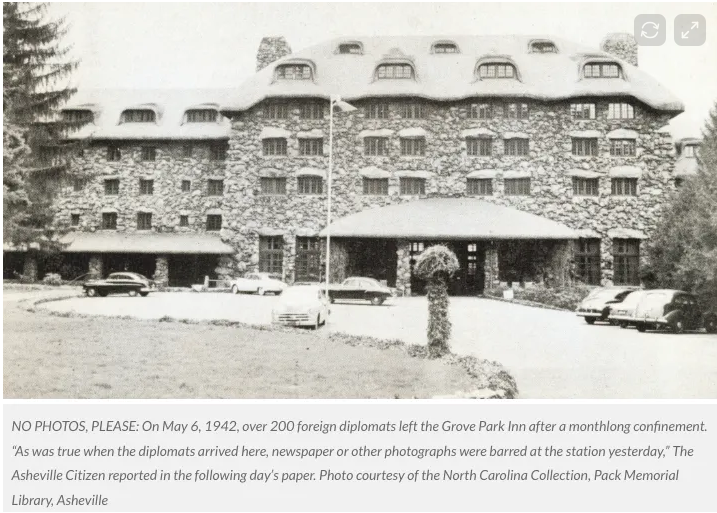
When the first group left May 6, 1942, the newspaper finally reported that 221 people had departed for their homelands as part of exchanges involving U.S. diplomats held abroad.
The diplomats had paid for their stay at the Grove Park Inn, according to the newspaper.
Meanwhile, 28 State Department officials and 48 guards were housed at the resort.
Their reported activities included shuffleboard, lawn bowling, badminton and bridge.
A luxury resort had effectively become a guarded diplomatic holding facility, with federal officials and guards living alongside foreign diplomats and their families.
Hundreds more followed
The first group was not the end of the story.
At least 400 additional people — including women and children — were interned at the Grove Park Inn between May and October 1942.
Again, newspapers generally waited until after groups had departed before publishing information about them.
One June 1942 report described the departure of 94 Japanese and 20 Germans who had been held at the resort for several weeks.
The newspaper described a scene at the train station in which a small group of spectators and law enforcement officers watched as the detainees departed.
Two middle-aged Japanese men waved from a car.
The spectators and officers did not wave back.
The photograph and newspaper account captured something that today is difficult to imagine: Asheville had become a temporary intersection of local law enforcement, federal authority and global conflict.
The same resort, a different world
More than eight decades later, the Grove Park Inn is again hosting foreign officials under a heightened security presence.
But this time, the officials are not detainees.
They are participants in economic diplomacy.
The G20 brings together the world’s major economies to discuss issues that can affect everything from American consumers and businesses to global financial markets.
For the Trump administration, the Asheville meetings are also an opportunity to promote its economic agenda, including growth, trade and tariffs.
Treasury Secretary Scott Bessent has emphasized economic growth as a central objective of the U.S. G20 presidency.
The gathering also comes as the administration increasingly treats economic policy as a national-security tool.
Tariffs can be used to pressure trading partners.
Sanctions can restrict access to the international financial system.
Foreign investment can raise questions involving sensitive industries and critical infrastructure.
Supply chains can become national-security concerns.
That means the people sitting around conference tables at the Grove Park Inn are discussing subjects that increasingly overlap with the work of Congress and federal law enforcement and national-security agencies.
Why this matters to Asheville
The G20 is ultimately about decisions being made by national governments.
But the security operation is intensely local.
An Asheville police officer working a checkpoint is dealing with the practical consequences of an international meeting.
A local emergency manager has to consider what happens if an emergency occurs near the venue.
Local agencies have to maintain normal services while federal officials secure the summit.
And residents have to navigate their city while some of its most prominent streets and properties temporarily operate under heightened security.
That makes the G20 a useful case study in federalism.
Washington can bring an international summit to Asheville.
But it cannot operate the summit without Asheville.
The federal government needs local police, firefighters, emergency managers, roads, hospitals and other infrastructure to make the event work.
At the same time, local authorities must protect their own residents while accommodating the federal mission.
That relationship is rarely visible to the public unless something goes wrong.
When it works, the summit can feel almost invisible.
From wartime hostages to economic diplomacy
There is perhaps no better place in Asheville to illustrate the evolution of American diplomacy.
In 1942, foreign diplomats arrived secretly at the Grove Park Inn after the United States entered a world war.
They were confined, guarded and largely hidden from the public.
Local newspapers agreed to withhold information at the request of the State Department.
The diplomats eventually left as part of exchanges involving Americans held overseas.
In 2026, representatives of foreign governments are arriving at the same resort to negotiate economic policy.
This time, their presence is public.
The meeting is not secret.
The participants are not prisoners.
And Asheville police are not guarding detainees.
They are helping protect guests.
But the underlying lesson from both eras is the same: International affairs do not remain confined to Washington.
Sometimes they arrive in Asheville.
And when they do, federal diplomacy depends on local public safety.
That is why the checkpoints around the Grove Park Inn are more than a temporary inconvenience or curiosity.
They are the visible edge of a national-security operation taking place in the middle of a North Carolina city — one with a history of serving as a backdrop for some of America’s most unusual encounters with international diplomacy.
